

By Debbie Sagorin, REALTOR(R) - Coldwell Banker Realty, Newport Beach
California DRE License #01411020 - ABR(R) - CNE - e-PRO(R) - Smart Home Certified - 21+ years in Orange County real estate - 350+ closed transactions (250+ in Irvine) - Top 1% of REALTORS(R) in Irvine - 11-time Five Star Real Estate Agent Award - 285+ verified five-star reviews - Long-time Woodbridge resident
Published February 3, 2026 - Reviewed for accuracy June 2026
Quick answer: Termite issues are common in Orange County, including Irvine. The right treatment depends on whether the home is attached or detached: for most attached homes, condos, and townhomes, full fumigation (tenting) is impractical or restricted by HOAs, so licensed local (spot) treatment is the typical approach. Detached single-family homes with widespread activity often warrant fumigation, which treats the entire structure at once. Most termite work can be coordinated during escrow with clear timelines and a written clearance before closing.
Termite issues are common throughout Orange County, and Irvine is no exception. Even well-maintained homes can show signs of drywood termites during inspections. The key is choosing the right treatment based on the type of property, the extent of activity, and whether the home is attached or detached.
Attached Homes and Condos: Why Tenting Is Often Not Possible
In Irvine, many homes are attached, including condos, townhomes, and some duet-style properties. When a home shares walls, rooflines, or attic space, full fumigation (tenting) is often not possible due to physical constraints, HOA rules, or both.
When tenting is not an option, the typical approach is local (spot) treatment. This targets active areas directly and is often the most practical, approved solution for attached housing, including many attached homes in Woodbridge and other Irvine villages.
When Fumigation Makes Sense
For detached single-family homes, especially when termite activity is widespread or in hard-to-access areas, fumigation may be recommended. Fumigation treats the entire structure at once, including voids where termites can live undetected.
When one of my listings needs tenting, I consistently recommend Western Exterminator. They are reliable, experienced, and understand how to coordinate fumigation smoothly during escrow. They are one of a small group of companies I trust for larger or more complex termite jobs.
A Real Irvine Example: Fumigation During Escrow
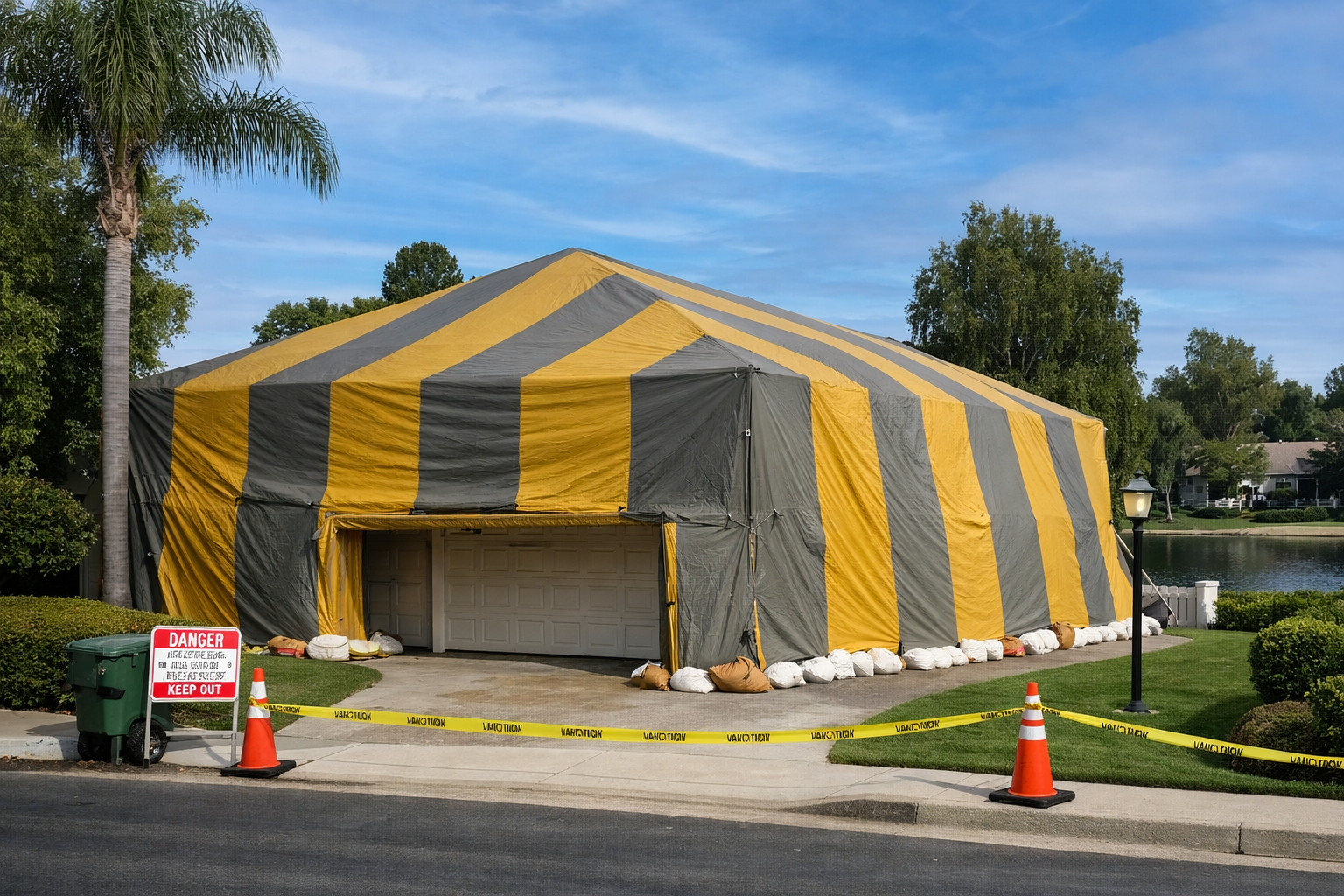
This Irvine home is currently in escrow and undergoing fumigation. My buyers secured the property off-market, so they avoided multiple offers while still addressing the termite work properly as part of the escrow process. For a deeper walkthrough of how termite work, inspections, and clearances fit into a transaction, see my full guide to the Irvine escrow process. And if you are still deciding how to work with a buyer's agent, my overview of the California Buyer Representation Agreement explains what that looks like.
Fumigation 101: What Homeowners Should Know
Fumigation is one of the most effective ways to eliminate drywood termites because it treats the entire structure, not just localized areas. During fumigation, the home is covered with tarps and filled with a measured dose of fumigant gas that penetrates wood, walls, and inaccessible voids where pests hide. After treatment, the home is aerated and tested with specialized equipment to confirm it is safe to re-enter.
How to Prepare Your Home
Homeowners play a key role in fumigation success by following the preparation timeline provided by the fumigation company. As soon as you schedule, plan accommodations for people and pets, coordinate gas shut-off with the utility, and confirm parking or security needs if required.
In the days leading up to treatment, you may be asked to move potted plants away from the structure, prune vegetation touching the home, retract awnings, and ensure the fumigator has access to all areas, including garages, closets, and any locked spaces.
On fumigation day, you must provide keys, evacuate all people, pets, and plants, shut off pilot lights and certain appliances as directed, and open interior doors, cabinets, and drawers so the gas can circulate and later dissipate efficiently.
Food, Medicine, and Nylofume Bags
Any consumable in an unsealed container (food, pet food, beverages, spices, medications, and similar items) must either be removed from the home or double-bagged in special Nylofume bags. Items in sealed glass, metal, or plastic containers with the original airtight manufacturer seal intact typically do not need to be removed or bagged.
Cold and frozen foods can usually remain in the refrigerator or freezer as long as they are properly double-bagged. Follow your fumigation company's instructions closely, since requirements can vary by provider and situation.
Nylofume bags are intended for food and similar items. Clothing, linens, toys, and other non-edible belongings generally do not need bagging because the fumigant is a gas that fully aerates and leaves no surface residue.
Special Situations to Discuss in Advance
Some home features require extra planning. Aquariums, burglar alarms, roof-mounted equipment, outdoor gas grills, and certain connected structures (such as shared conduits or drains) may need specific steps. Tree limbs over the roof may need trimming to allow proper tarp placement. Highly valuable items are best removed because fumigation companies generally do not assume responsibility for theft or vandalism.
Safety, Re-Entry, and What Happens After
Licensed fumigators follow strict safety protocols and test the air until fumigant levels are below the U.S. EPA re-entry standard. In California, a clearance notice is posted once the structure is certified safe. Do not re-enter until that clearance is given.
After fumigation, you do not need to wash dishes, clothing, or linens because the fumigant is a gas that leaves no residue and fully dissipates from the structure and its contents.
The Bottom Line for Irvine and Orange County
Not every termite report calls for the same solution. In Irvine especially, attached versus detached construction matters, and HOA rules can affect what is possible. The best approach is a strategic one: match the treatment to the property and the scope of activity, and rely on licensed professionals for recommendations and clear preparation steps.
Important: This article is for general information only. Always follow the instructions provided by your licensed termite or fumigation company, and confirm any HOA requirements that apply to your property.
Termite Treatment FAQ
Is termite fumigation always required in Irvine homes?
No. Many Irvine homes are attached - condos, townhomes, and some duet-style properties - which makes full fumigation impractical or restricted by HOA rules. In those cases, licensed local (spot) treatment is commonly used and is widely accepted by lenders during escrow.
Can a home be fumigated while in escrow?
Yes. Fumigation is regularly coordinated during escrow in Orange County. The fumigation company schedules tenting, aeration, and a clearance notice that gets delivered to escrow, typically all wrapped up before the close-of-escrow date so the buyer takes possession of a cleared home.
What is the difference between local termite treatment and fumigation?
Local treatment targets specific active areas - usually with foam, dust, or borate products - and is well suited to attached homes where tenting is not possible. Fumigation tents the entire structure and uses a measured dose of fumigant gas to reach hidden voids. For widespread drywood termite activity in a detached single-family home, fumigation is often the more thorough option.
How long does fumigation take in Orange County?
Most single-family fumigations in Orange County take roughly 48 to 72 hours from start to clearance. The home is tented and treated, then aerated and tested until fumigant levels are below the U.S. EPA re-entry standard. The licensed fumigator posts a clearance notice once the structure is certified safe to re-enter.
Who pays for termite work in an Irvine real estate transaction?
It is negotiable and depends on the contract terms. In Orange County, it is common for the seller to handle Section 1 (active infestation) items so the home delivers cleared at close of escrow, while Section 2 (conditions that could lead to future infestation) items are negotiated case by case. Your agent should review the termite report carefully and negotiate based on the inspection findings, loan requirements, and overall deal economics.
Related Reading
- Mastering the Escrow Process: Your Essential Guide to Irvine Real Estate Transactions
- The California Buyer Representation Agreement Explained
- Why Setting the Right Price Is More Crucial Than Ever
- The Limits of Zestimates: Why You Should Rely on an Irvine Expert
- Woodbridge, Irvine - Village Overview
Looking for the Right Realtor in Irvine?
If you are looking for a Realtor in Irvine who understands inspection issues, termite work, and how to coordinate it all during escrow, Debbie Sagorin is one of the most experienced agents working this market. With 21+ years of local experience, 350+ closings in Orange County (250+ in Irvine alone), and deep village-by-village knowledge - from Woodbridge and Northwood to Turtle Rock, Woodbury, Westpark, Oak Creek, El Camino Real, Quail Hill, and the newer master-planned communities - Debbie helps buyers and sellers make confident, data-driven decisions.
📞 Call or Text: 949-537-2079
🌐 HomesForSaleInIrvine.com
📩 Contact Debbie Sagorin
About the Author
Debbie Sagorin is a REALTOR(R) with Coldwell Banker Realty in Newport Beach (California DRE #01411020), with 21+ years of Orange County real estate experience and 350+ closed transactions, including 250+ in Irvine. She is a long-time Woodbridge resident, ranks in the Top 1% of REALTORS(R) in Irvine, holds ABR(R), CNE, e-PRO(R), and Smart Home Certified designations, and has earned the Five Star Real Estate Agent Award 11 times. Contact: 949-537-2079 - [email protected]